


New here? I write both “expository” articles and stream-of-consciousness style “sermons” and/or musings (which come out on Sundays). There’s something for everybody! Today’s topic is my weight loss attempts and body image issues I had in both my 20s and early 30s, stuff I’ve learned about myself through experiencing it, and what I think about it all now. I hope you find it interesting and/or helpful. Also, in contrast to past versions of me, I didn’t proofread this article… because you can’t proofread stream of consciousness ;-)
I’ve had a love/hate relationship with my body (and food) for most of my life.
I remember thinking I was fat as early as second grade.
I’d started reading Teen and Seventeen magazines by age 12, not realizing I was allowing unrealistic beauty standards to be programmed into my very impressionable brain.
I was borderline anorexic in middle school. I’d throw away my lunch sometimes. Joined the track team just for the exercise. Even passed out from low blood sugar during chorus practice one afternoon!
My happiness with myself heavily depended on how thin I perceived myself to be.
When I studied abroad in Germany during college, I taught myself to cook. I lived in a dorm with the tiniest little efficiency kitchen. It had a 2-burner cooktop, mini fridge, and sink… with a 6-inch wide area to set dishes to dry.
It was my first kitchen away from my parents’ house. I remember LOVING going shopping for groceries for the first time. I was amazed at what $20 purchased me (or 13 Euros at the time — it was 2007).
I also thought I needed to lose weight… pretty much the whole time. I look back at photos of myself — clearly not fat, like… at all — wearing size 6 jeans, but wanted to be size 2 or 4. Six was too large.
I worked out for sometimes 2 hours a day, every day. I ate like crap, though, and I’d go for happy hours with friends at least once a week. It wasn’t until my mid 20s that I’d figure out the nutrition stuff and make some changes to my diet!
In late 2011, I became a Certified Personal Trainer after a four-month long full-time tuition program at the National Personal Training Institute. I had a handful of private clients and also taught spinning, water fitness, and circuit training classes.
I was obsessed and highly insecure with my weight for nearly all of my 20s and wouldn’t even wear a bikini in front of my family.
Fast forward to age 39, I’m living in my van, married to a wonderful, scrappy (SUPER capable) and handsome man, 30 whole pounds heavier than I was five years ago, and infinitely happier too.
How did that happen?! I never thought I’d be this weight and completely unhorrified by it.
My husband Edward and I eat at restaurants frequently since we’re always traveling through new cities. We love local vegan restaurants the most, but we’ll also hit up a Yard House or Cheesecake Factory from time to time.
I have a full kitchen in my van with all the essentials, but we don’t always feel like turning my van into a food truck when we’re just overnighting somewhere, like at a truck stop. It’s more fun to cook when we’re parked in a cool spot for a few days.
Still, cooking “at home” — even if home is on the road — makes it way easier to count calories.
And since I do find myself wanting to shed some excess weight, I need to know how many calories I get to eat while also creating the environment my body needs to let go of it.
You know EXACTLY what is in the food you make for yourself (at least you should, anyway)!
You give yourself the most control over your health when you make your own food.
You can never really know what’s in restaurant food, either.
Restaurant food is FULL of extras. Extra sugar, extra oil, extra salt, extra everything that makes food addictive… and large portions encourage extra bites that don’t seem like much.
Restaurant food is delicious. It’s also expensive. You can save a lot of money cooking for yourself compared to Door Dashing or going to restaurants. I know there have been times where me and Edward have spent more on Door Dash in a week than we would’ve spent for a month’s worth of food at Costco!
So… saving money AND calories? I’m SO here for it!!
Before I do something — even start a calorie deficit — I have to see the reward in it.
Because I’m HAPPY right now, even though I’m slightly overweight. Why should I disrupt my peace by going into a calorie deficit for months in order to slowly shed unnecessary pounds? That sounds… boring, difficult, uninteresting…
Eureka!
If I’m telling myself that it’s gonna be boring, difficult, and uninteresting, it makes it far less likely that I’ll even start the process, much less follow through.
Maybe I’ve been negatively influenced by years of marketing and messaging about how hard it is to lose weight. What if none of it’s true and it’s actually easy (even fun) to lose weight?
If I can make going into a calorie deficit interesting and easy, then it logically becomes more fun.
Dropping extra pounds can even be a game. You get to make the rules!
How can I make 1450 calories (or whatever your number is) delicious, satisfying, and nutritious?
The irony of this is that I used to cook delicious, satisfying meals a lot. I was slim, then… even though I was afraid of being fat.
(I know, it’s insane. It was my biggest fear at the time)
I had somewhere between 50-100 cookbooks at one time. Mostly vegetarian and vegan ones. Maybe I was a little obsessed.
Many of those cookbooks are on the shelf in my pantry at home in Florida.
But I rarely if ever use them now. These days, when I want to make a meal, I choose from what’s right in front of me. It makes sense that I hadn’t been making many meals lately, since I didn’t have a good plan to keep things on hand/stocked in the van that I could use to make meals.
I was usually just flying by the seat of my pants with some random hodgepodge of ingredients I didn’t know what to do with.
There wasn’t much intention in elevating my nutrition experience. It was just basic “I’m hungry, let’s eat…” and then I’d proceed to eat more than what I needed. Repeat. Do that lots of times — like I did — and it’s very easy to slowly put on weight without even noticing.
So how do we make the calorie deficit easier and less of a grind, more fun and less tedious, and most importantly… how do we make it delicious?
I thought to myself if I had 10-12 “staple” DELICIOUS yet healthy recipes (including desserts!) that I can make within 10-15 minutes, then I could program those into Chronometer really easily and be able to stay in a calorie deficit with a lot less math and guesswork.
One thing I loved about being a personal trainer and nutritionist for several years was inviting people over for 3-course dinners or potlucks where ALL the food was plant-based.
A lot of people I invited didn’t know my mac n’ cheese was dairy-free or had SQUASH in it. I loved the look of surprise on their faces when they tasted it and loved it! It was delicious even though it wasn’t covered in cheese or full of oil and salt.
So when I had the idea of 10-12 recipes on rotation to help me lose weight, I also thought about how I’d always “healthify” previously unhealthy foods. I’d still make pizza, but I’d leave off [most of] the cheese… and get creative with toppings and drizzles.
Think kale, white beans, garlic, barbeque sauce, a squeeze lemon juice, and some black pepper. Possibly a tiny bit of shaved parmesan, just for flavor.
On a delicious homemade crust? Or even a “clean” storebought one? YUM!
The last two mornings, we’ve had homemade waffles!
We got the “organic classic” Birch Bender’s pancake and waffle mix from Safeway last week, so it’s not technically homemade, but I’m using this mix up before switching back to my go-to (and gluten-free!) waffle mix. I also swapped the oil for applesauce and couldn’t tell any difference.
We added some organic blueberry jam, banana slices, and this spectacular Madagascar vanilla-infused organic maple syrup (in a GLASS bottle) from Costco… this big ol’ waffle has just 2g of fat, 5g protein, and 513 calories:
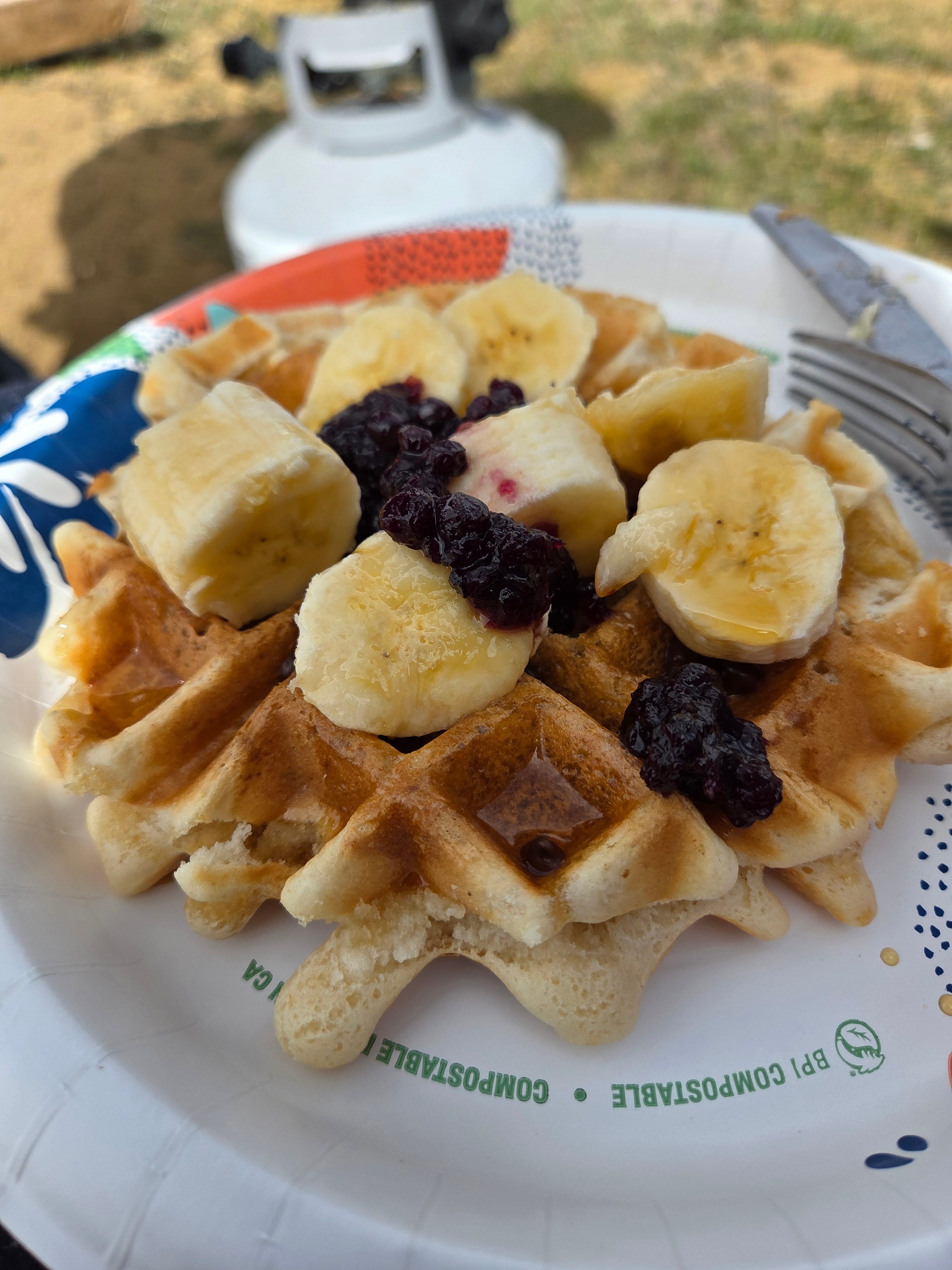
It’s been two and a half hours and I’m still satisfied from breakfast. Satisfaction is as much psychological as it is physical. I want to enjoy my food!!
(Oh, and if you’re wondering what kind of waffle iron I use, it’s this one that has ZERO forever chemicals in it! And I NEVER need to spray it with oil. And it’s easy to store in the van.)
I weighed the waffle and all the toppings so I could add them into Chronometer.
How delicious can I make my calorie deficit?
How healthy can I make delicious food?
It seems like a fun challenge to me.
The best part is the amount I am getting to practice not judging myself. Like yesterday, I was SOOOO hungry and wanted to eat constantly all day. I allowed myself to eat when I was hungry and my deficit ended up only being -200 calories. But I still ate way less than I had been eating, so it was still a win.
Often times when I’d wanted to lose weight in the past, I’d get consumed by perfectionism. If i didn’t have the biggest possible deficit, if I didn’t know exactly how many calories were in something, or I forgot to measure what I ate before i ate it… I’d start telling myself that tracking calories was too tedious and “not sustainable.”
And I’d quit within weeks. Just fell off the wagon and never got back on.
But for something to be sustainable, it needs to be enjoyable.
And if something is too tedious, there’s got to be a way to systematize it to remove the tedium.
Enter Grok and Chronometer.
I tell Grok what I’m eating, how I prepared it, how much of everything I used, and it tells me how many calories it is. I then log it into Chronometer. You could totally skip Grok if you want, and just input everything into Chronometer, but I find Grok helpful to keep track of everything as I go along, then when I’m relaxing after the meal I can add it in.
Grok is also great for brainstorming those 10-12 staple meals and even offering you recipe links to what you’re looking for! You can import those recipes it finds into Chronometer or another calorie-counting app. It’s like a coach or assistant.
Do whatever works and that you’ll do consistently!
And LOG IT ALL! Even if I’m just drinking a Spindrift for 3 calories, it’s getting logged.
We just need awareness of what’s going into our bodies… so we can make sense of what’s going on with our bodies.
I can admit it: I’ve definitely been eating more calories than I’ve been burning over the last 3-4 years especially.
And y’all, I don’t know if you’ve noticed this, but it is way easier to eat 500 calories than it is to burn it.
It’s also easier to eat 500 calories less… than it is to burn 500 calories more!
In many ways, I was making “weight release” harder because I was telling myself it was too hard, tedious, etc. when the truth is it’s just input manipulation. No need to add emotion into it. We can math-and-science this.
You get out what you put in. If I’m not willing to become mindful of the amount of energy I’m consuming, then I can’t be surprised if that lack of mindfulness results in weight gain.
It makes sense that if I do become more mindful, though, that the mindfulness would result in weight loss.
Mindfulness is non-negotiable. So much of eating has become mindless and pop-culturey.
Like how you’re supposed to buy half-gallon plastic jugs of this liquid called “egg nog” around Christmas time. Peppermint tea would be just as satisfying!
You’re supposed to buy a bucket of popcorn covered in fake butter when you go to the movies.
And it doesn’t help that sooooo much food out there isn’t really food. It’s been engineered to be addictive. It’s “dead” food.
Packaged, preserved food of any kind is dead. Kombucha is dead. Even Spindrift in its aluminum, plastic-lined can isn’t alive. Yes, they used fresh fruit juice when they first made it, but it ain’t fresh anymore!
The more meals made of whole foods, the better. Last night I made us steamed potato bowls with baked beans and garlicky kale drizzled with truffle hot sauce. It was divine!!!
(There are no photos of this dish — it was gone FAST!)
Whole foods are best because they are nutrient dense. Processing changes the nutrient content and absorbability. There are more vitamins in fresh-pressed orange juice than the pasteurized/homogenized kind in the plastic bottles or cartons in the grocery store. WAY more vitamins.
It’s not always practical, though. Fresh isn’t always available. In the van, we usually have a bag or two of frozen organic veggies that are quick/easy to make into a dinner.
I’m hopeful that if I can teach myself to be more present, find the joy and fun in any “mission” I set upon in life — like weight loss — that it pretty much guarantees my success.
For any change to be permanent, it has to be sustainable, enjoyable, and self-initiated. That’s why so many fad weight loss programs don’t work long term, because if you rely on factory-made food (e.g. Nutrisystem) or a weight loss shot, you depend on those items being available for your weight loss to continue (or to maintain).
Cooking puts the power in your hands. I hate it when people say “calories in, calories out” is all that matters when it comes to weight loss, too. That’s a separate soapbox, but you could eat 1500 calories of Oreos and still be starving because none of the “food” you ate had any nutrients. Your body is hungry not for calories but for nutrients.
The more nutrient-dense your food is, the more your hunger can be tamed. It’s not JUST calories your body needs to lose weight — because it’s not just calories your body needs to function.
Liver health is also key to weight loss. If the liver is overburdened by processed food, prescription drugs, and additives in our skin and personal care products, it will have fewer resources available to process the weight loss.
Weight loss is just one function the liver helps with — it has over 900 more known functions. Some say there are over 2,000 functions (many that science has yet to discover).
(Read the book Liver Rescue for more on the fascinating liver and its role in weight gain/loss).
Trendy high-fat diets promote liver sluggishness over time. It may appear to work initially for weight loss, but over the long term, it strains the liver (one of whose job it is to process fat). Fun fact: If the liver is unwell, it can be a root cause of unexplained weight gain and inability to lose weight.
Reducing fat (and increasing hydration) just gives the liver a break.
In my case, the reason for my 30-lb weight gain was threefold: getting divorced/healing from burnout + eating too much, too often and… falling in love.
I call the extra weight “love fluff” — because in the time I gained it, I really learned to love myself in a way I never had before. Plus, meeting Edward and being so comfortable and cozy in our little love bubble did NOT help at all in keeping extra pounds from creeping on :) He’s a big dude and needs more calories than I do, but I’d often find us splitting meals down the middle and, instead of saving some for later, I’d eat the exact same amount of food as my 6’1” husband!
It’s easy to see how the extra pounds came on.
My habits of daily workouts + home cooking most of the time went out the window probably in the first 1000 miles I was on the road in my van!
I find it sooo much easier to create habits when I’m not driving around the country in a van.
When I lived in a house, I had a dedicated workout space. I could wake up, get ready, have a small snack and start a workout. Here in the van, every space is used for 1-3 other things at the same time. I can’t get to my Instant Pot or juicer if I’m walking on my treadmill. There are often ants outside that make rolling out my yoga mat in a random campsite a liiiittle risky.
Part of the role of the extra weight, I’ve discovered, is to face it head on and accept myself.
Not judge myself or disrespect myself because of my size or how my clothes fit.
I used to be terrified of being this weight. Of being “this big.”
(I’m a size 10! LOL)
I do feel slightly uncomfortable at this size — and a bit heavy for my height — but none of that is an emergency. Yet for most of my life, “feeling fat” WAS an emergency.
It would quite literally consume my every thought.
So when I’m tracking my calories today, there’s some part of me who remembers that… and fears it.
It’s me that’s been making it hard.
Not wanting to fall back into those extremes, the obsession, the secret shame, the imbalance of it, I swung like a pendulum to the other side of the spectrum… where I’m not wanting to “go there” at all.
But losing weight is actually easy when you intentionally create an environment (and a system!) where you 1) don’t feel deprived, 2) can eat delicious, filling food, and 3) you can seek out awareness, joy, and gratitude in the process too.
I find that being more aware of what I’m eating not only makes it easier to be in a calorie deficit, it also gives me an opportunity to feel grateful: for the ingredients, the people I’m eating with, the ability and time it took to make it, how delicious it is without being a detriment to my health… the gratitude list goes on and on.
It’s so important to take care of ourselves. The quality of our instrument (body) affects the quality of our entire lives.
Here’s a question I like to ask myself too: If I feel like crap because I’ve been eating dead, processed, manipulated food-for-profit for a long time, what would happen if I ate more homemade and living foods instead?
Logical reasoning points to me feeling a whole lot better, and probably dropping some of my love fluff easily… without obsessing over it this time!
I’ll let it be experimental. I’ll just take a few consistent actions every day that I suspect might make me feel better and release some weight… and see if I’m right.
Spoiler alert: My husband says I’m right a lot.
Happy Sunday,
Cait